

Analysis | Multi-Domain Command & Control (MDC2): Why Ground Stations Are Becoming the Nerve Center of Joint Operations?
Why the future of multi-domain warfare will be decided not in orbit, but on the ground where data, command, and coalition power converge.

Modern warfare is no longer defined by platforms. It is defined by connectivity.
The decisive advantage in today’s conflicts does not come from having the most advanced satellite, aircraft, or missile system in isolation, but from how effectively commanders can sense, decide, and act across domains, space, air, land, sea, cyber, and the electromagnetic spectrum, in near real time. This is the core promise of Multi-Domain Command & Control (MDC2).
While much attention is placed on satellites, ISR aircraft, autonomous systems, and AI-enabled decision tools, the less glamorous truth is this: none of it works without ground stations. Ground infrastructure, once treated as static support equipment, is rapidly becoming the nerve center of joint and combined operations.
From my perspective, MDC2 will not succeed or fail in orbit or in the cloud. It will succeed or fail on the ground.
From Platform-Centric to Network-Centric Warfare
Historically, command and control architectures were domain-specific. Air forces managed air tasking orders, navies controlled maritime battlespace awareness, and space commands operated satellite fleets largely in isolation. Information sharing was episodic, delayed, and heavily hierarchical.
That model is collapsing.
The U.S. Department of Defense, through initiatives such as Joint All-Domain Command and Control (JADC2), has made it clear that future operations demand persistent, cross-domain integration. Similar thinking is visible in NATO’s Digital Backbone, the UK’s Multi-Domain Integration doctrine, and Australia’s Joint Integrated Warfighting framework.
What connects these efforts is not a single sensor or platform, but a joint tasking architecture that allows data to flow seamlessly across domains and classification levels.
And that architecture converges on the ground.
Why Ground Stations Are No Longer “Support Infrastructure”
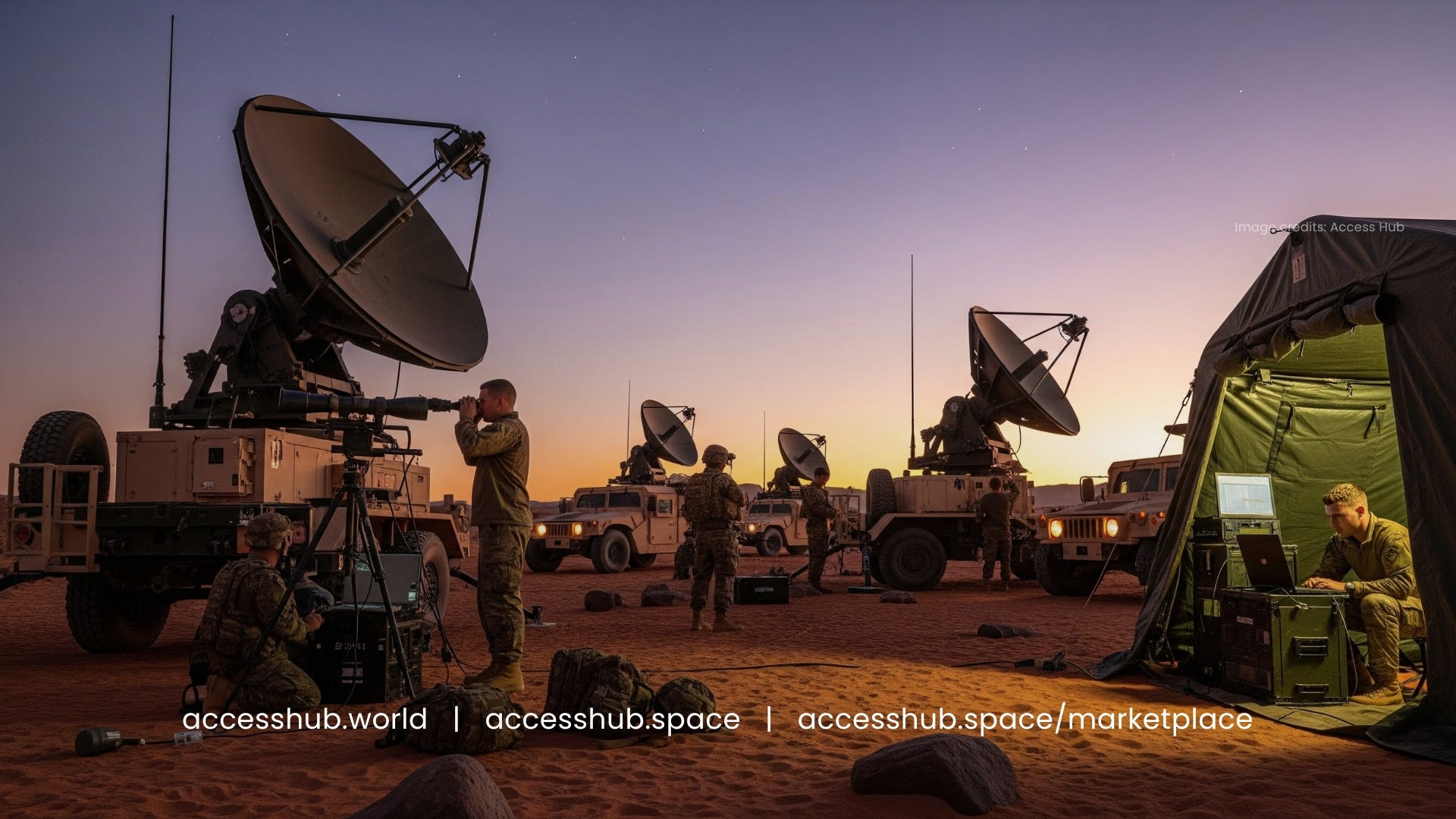
For decades, ground stations were designed around satellite control and telemetry. They were geographically fixed, mission-specific, and often proprietary.
MDC2 changes that equation fundamentally.
Today’s ground stations are expected to:
Fuse data from space, air, maritime, land, and cyber sensors
Support real-time tasking and re-tasking of assets
Enable coalition interoperability across allied forces
Operate in contested, degraded, and denied environments
This evolution is visible in programs such as the U.S. Space Force’s Enterprise Ground Services (EGS), NATO’s Alliance Persistent Surveillance from Space (APSS), and France’s Syracuse IV ground modernization efforts.
Ground stations are no longer peripheral; they are operational command nodes.
The MDC2 Data Problem: Volume, Velocity, and Trust
MDC2 is fundamentally a data orchestration challenge.
A single modern operation may involve:
Electro-optical and SAR satellites
Signals intelligence payloads
Maritime patrol aircraft
UAV swarms
Cyber threat sensors
Electronic warfare systems
Each generates high-volume, high-velocity data streams in different formats, latencies, and security domains.
Ground stations are where:
Data is ingested
Normalized
Fused
Prioritized
Routed to decision-makers or autonomous systems
Companies such as Northrop Grumman, Raytheon, and Lockheed Martin are increasingly positioning their ground solutions as data fusion and decision-enablement platforms, not just satellite control systems.
At the same time, newer players like Palantir and Anduril are influencing military thinking by emphasizing software-defined, sensor-agnostic command layers that sit atop ground infrastructure.
The implication is clear: MDC2 is shifting ground stations from hardware-centric to software-defined battle management systems.
Standardization: The Hardest Problem No One Likes to Talk About
Despite all the rhetoric around joint operations, C2 standardization remains deeply fragmented.
Different services, allies, and platforms still rely on:
Proprietary data formats
Incompatible interfaces
National security-driven silos
This is where ground stations become both a bottleneck and an opportunity.
Efforts such as:
The U.S. DoD’s Modular Open Systems Approach (MOSA)
ESA’s push for interoperable ground architectures through ESA Ground Segment Evolution
All attempts are made to make ground nodes interoperable by design.
However, standardization is not just technical; it is political, commercial, and cultural. Vendors still compete on lock-in. Militaries still protect legacy investments. Allies are still classified differently.
My assessment is blunt: without enforced ground-segment interoperability, MDC2 will remain a slogan rather than an operational reality.
Real-Time Tasking: From Hours to Seconds
One of the most underappreciated shifts enabled by modern ground stations is real-time or near-real-time tasking.
In legacy architectures:
Satellite tasking cycles ran in hours or days
ISR re-tasking required multiple approval layers
Feedback loops were slow and brittle
Modern conflicts, from Ukraine to the Red Sea, demonstrate that relevance is measured in minutes, not missions.
Ground stations now act as:
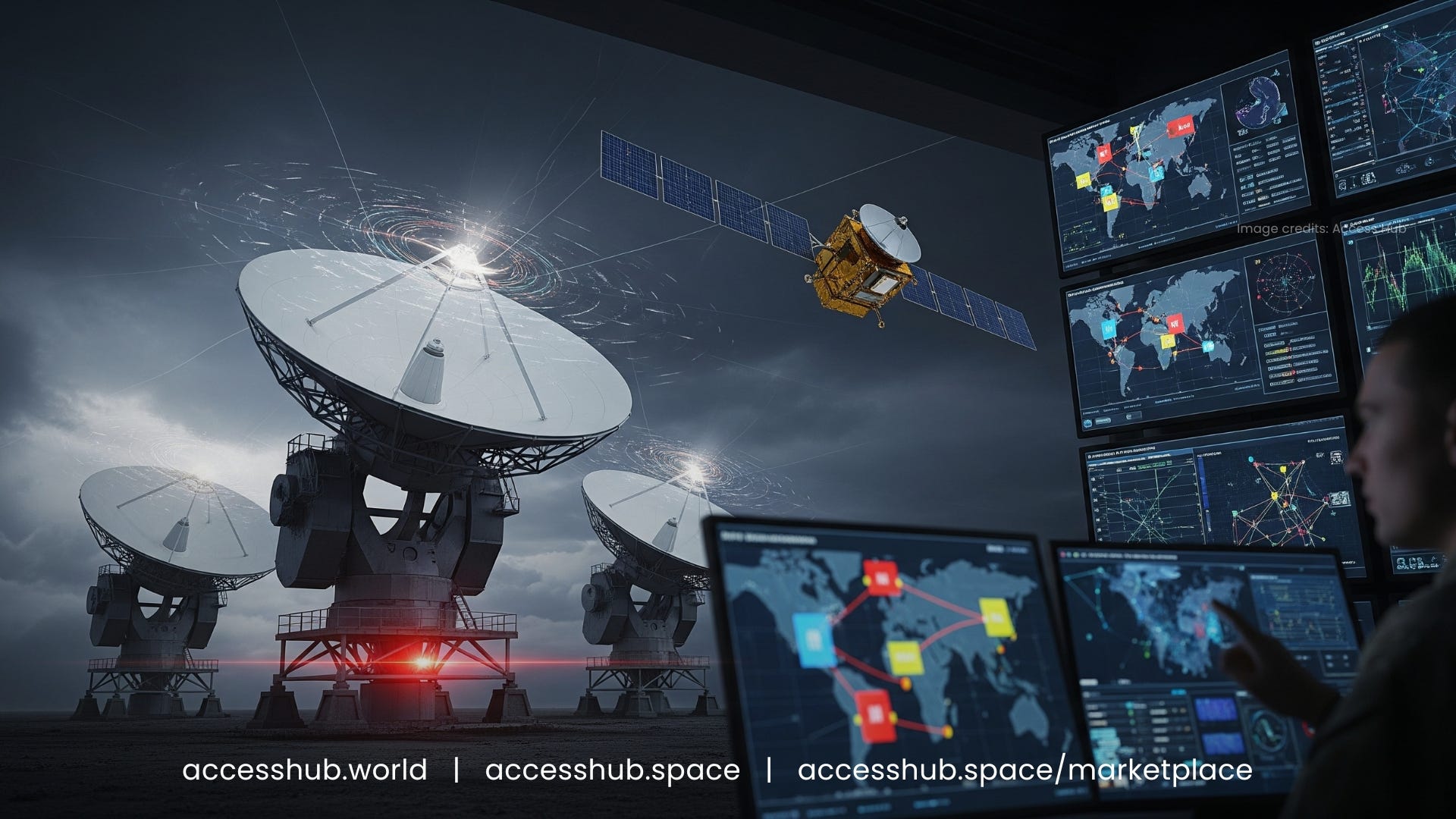
Real-time brokers between sensors and shooters
Dynamic allocation engines for ISR assets
Command interfaces for autonomous systems
This is evident in how organizations like U.S. Space Systems Command and NRO are integrating commercial ISR providers such as Vantor, Planet Labs, and BlackSky into military ground architectures.
The battlefield advantage increasingly lies in how fast ground systems can close the observe–orient–decide–act (OODA) loop.
Ground Stations as Coalition Gateways
MDC2 is not just a joint; it is combined.
Operations today almost always involve coalitions, whether NATO, Indo-Pacific partnerships, or ad hoc security groupings. Ground stations are where:
National data sovereignty meets operational necessity
Classification barriers must be dynamically managed
Coalition trust is either enabled or broken
Programs such as NATO’s AIRCOM and the Five Eyes intelligence framework rely heavily on ground-based integration layers to share selected data while protecting sensitive sources.
This is driving demand for:
Attribute-based access control
Cross-domain solutions (CDS)
Policy-driven data release mechanisms
Ground stations are becoming diplomatic infrastructure as much as military infrastructure.
Market Structure: Who Is Competing for the Ground Layer?
The MDC2 ground segment market is fragmenting into distinct but overlapping player categories.
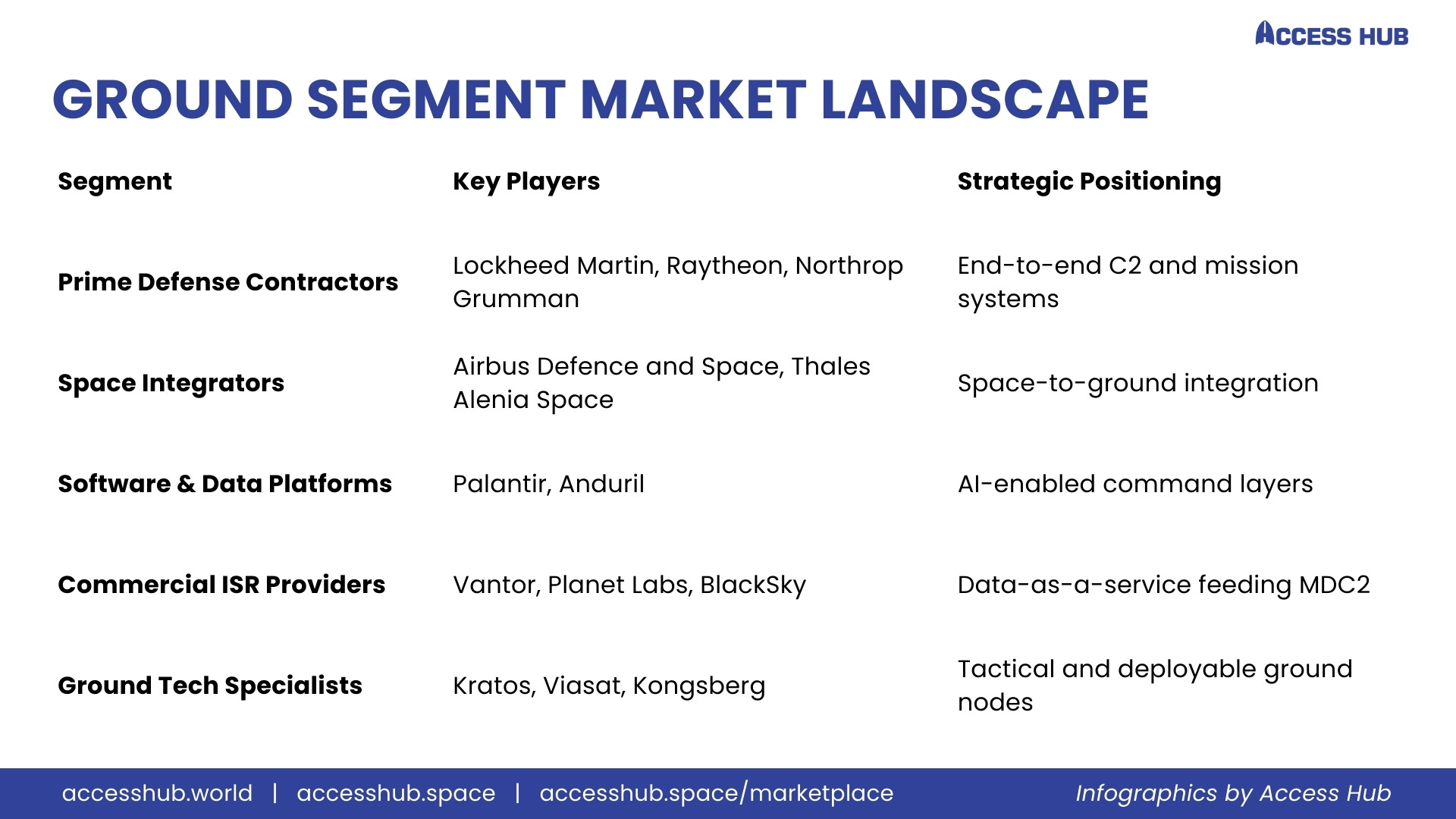
What is striking is how commercial and defense players are converging on the same ground-layer problem from different angles.
Contested Environments Change Everything
Ground stations were once assumed to be secure rear-area assets. That assumption is obsolete.
Modern ground nodes must operate under:
Cyber attack
Electronic warfare
Kinetic threat
Supply chain disruption
This is driving investment in:
Distributed and mobile ground stations
Cloud-native but edge-resilient architectures
Rapid reconstitution and failover capabilities
The U.S. Space Force’s focus on resilient ground architectures and DARPA’s Blackjack program reflect this shift.
In MDC2, resilience is not optional; it is the mission.
My Strategic Take: MDC2 Will Be Won or Lost on the Ground
From a strategic standpoint, MDC2 is often framed as a technology race: AI, autonomy, space sensors, hypersonics.
That framing is incomplete.
The real competition is over who controls the integration layer:
Who fuses the data
Who sets the standards
Who governs tasking priorities
Who enables coalition access
Ground stations sit at the center of all four.
The militaries that treat ground infrastructure as a strategic weapon system, rather than a support function, will dominate future joint operations.
For the industry, this means:
Ground systems are no longer back-office contracts
Software, interoperability, and integration matter more than raw hardware
Long-term advantage lies in being an architect, not just a supplier
MDC2 is not about connecting everything. It is about making sense of everything fast enough to matter. And today, that sense-making happens on the ground.
Today’s defense and space markets reward those who act on intelligence, not just collect it. That’s where Access Hub steps in.
We go beyond headlines to decode market movements, connect innovators with decision-makers, and help organizations convert strategic insight into real business traction across Space, Defense, Aerospace, Maritime, Media-Tech, and Energy Markets.
If your team is navigating these fast-moving domains, Access Hub is your partner for clarity, connection, and competitive edge. Contact us at: www.accesshub.world